Best way to pay when traveling abroad: cards, cash, fees
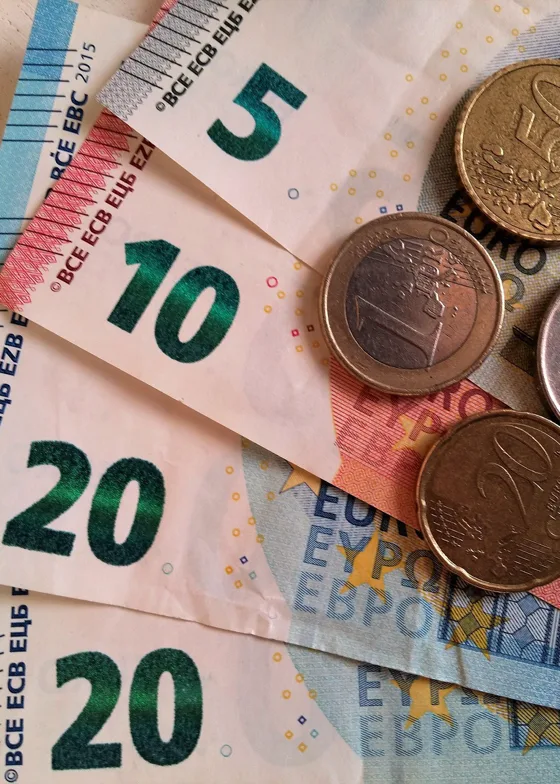 Image by peter-facebook · Pixabay-licentie · via Pixabay.
In this letter
Short answer: Use a card with no foreign transaction fee, always choose local currency when a terminal asks, and carry a small cash reserve. On $3,000 of spending, that costs you $0 in fees. The common mistakes cost $90 to $240 if every purchase is hit.
The $3,000 example: four ways to pay, four totals
Say you spend $3,000 on a trip: hotels, meals, trains, shops. Here is what the payment method alone costs you.
| How you pay | Fee assumption | Cost on $3,000 |
|---|---|---|
| Card with no foreign transaction fee, local currency | 0% | $0 |
| Card at the average fee WalletHub reports | 1.59% | $47.70 |
| Card with a typical 3% fee | 3% | $90 |
| Any card, “pay in dollars” accepted at the register | 8% markup (Mastercard’s merchant-guide example) | $240 |
| All spending as ATM cash: ten $300 withdrawals | $5 flat per withdrawal plus 3% bank fee (our assumption) | $140 |
The first row is not free in every sense. You still get the card network’s exchange rate, and we have not priced that here. But it carries no fee on top.
The 3%, 1.59% and 8% figures come from the sources in the sections below. The ATM row is our own illustration: ATM operators and banks set their own fees, so replace $5 and 3% with what your bank’s fee schedule says.
The surprise is the fourth row. A card with no foreign fee does not protect you from the register asking whether you want to pay in dollars. That choice can cost more than the card fee you shopped around to avoid.
Foreign transaction fees: 1-3%, and how to check yours
Foreign transaction fees on credit cards are usually 1% to 3% of the purchase, and 3% is the figure that shows up most often, per Capital One’s explainer. WalletHub, using its own card report, gives a lower average of 1.59%. Treat that as an average across many cards, not what your card charges.
To check yours, do three things before you book:
- Open your card’s rates and fees table (the “Schumer box” or pricing page) and find the line for foreign transactions.
- Look at your debit card too. Debit cards often carry fees, and they are the ones you use at ATMs.
- If the fee is 3%, add a no-fee card to the wallet before the trip. Keep your old one as a backup, because a single card that gets blocked or lost is the real trip-ruiner.
At 3%, a $3,000 trip costs $90. That is about the price of a couple of dinners, so it is worth a switch if you travel once or twice a year. It is not worth opening a card you would not otherwise want.
The DCC question at the register (and at the ATM)
DCC, dynamic currency conversion, is the offer to charge you in dollars instead of the local currency. It looks helpful because you see a familiar number. The catch is the exchange rate.
Mastercard’s own guide for merchants shows an example with the ECB rate plus an 8% markup for the dollar charge. That is an example, not a rule, and rates vary by merchant and provider. But it shows how the arithmetic works: the convenience is priced into the rate. If you choose the local currency, your own bank sets the rate and fees, as the same guide notes.
Our rule is simple: when the terminal asks, pick the local currency. The same applies at ATMs, where the screen may offer to “guarantee” your rate. Decline.
At a register, the question can be phrased oddly or the staff may press the button for you. Check the screen before you enter your PIN, and look at the receipt: if the total is in dollars, you were converted. You can ask them to cancel and run it again in the local currency.
ATMs abroad: whose fees you pay
Three different parties can charge you for one withdrawal:
- The ATM operator, with a flat fee or a percentage, sometimes shown on screen before you confirm.
- Your own bank, with a foreign fee on the withdrawal, and sometimes a cash-advance fee if you use a credit card.
- The conversion, if you accept dollars at the machine.
You cannot control the first fee much, except by choosing a bank-owned ATM over a standalone one in a tourist area. You can control the number of withdrawals. Ten $300 withdrawals pay the flat fee ten times. Three $1,000 withdrawals pay it three times, but leave you with more cash to keep safe. We’d go in the middle: one withdrawal on arrival and another if needed.
Do not use a credit card for cash unless you must. Cash advances usually start charging interest at once. Check your issuer’s terms.
How much cash, per destination type
We don’t have a primary source that ranks countries by card acceptance, so we’d rather not give you a list of countries and pretend it is data. Instead, here is how we think about it by type of place. Size the amounts with the daily numbers in our daily travel budget piece.
| Where you are | Cards work for | Cash still helps for | What we’d carry |
|---|---|---|---|
| Big cities, chain hotels, big restaurants | Almost everything, including contactless transit in many places | Tips, small kiosks, a taxi whose terminal is “broken” | A day of small spending |
| Small towns and rural areas | Hotels and some restaurants | Family-run guesthouses, village shops, local buses, parking | A few days of small spending |
| Markets, street food, festivals | Rarely | Nearly everything | Small notes, enough for each visit |
| Remote trails, islands, national-park gateways | Unreliable | Fuel, fees, food, any place with a weak signal | More than you think, plus a backup card |
Before you go, check three things for your specific destination: whether your hotel takes cards at the desk, whether local transit takes contactless, and whether any places you plan to visit are known as cash-only. A recent forum post from someone who was there last month tells you more than a country-wide rule.
What we carry
- One card with no foreign transaction fee as the main card, and a second card on a different network as backup, kept in a different place.
- A debit card for ATM withdrawals, with its fees checked in advance.
- A small amount of local cash from an ATM on arrival, not from an exchange booth at the airport. We’d skip buying currency before the trip unless a taxi or train from the airport requires it.
- A phone with contactless payment set up, plus the physical card. Terminals fail.
- A habit: local currency, every time, at every terminal.
If you want to cut the trip’s costs further, the payment method is one of the easiest places to start, because it needs no change to your plans. For the bigger numbers, see how much a day really costs in our budget benchmarks.
Last checked: Nov. 26, 2026. Fee figures come from Capital One, WalletHub and Mastercard’s 2025 merchant guide; your own card’s terms always win.
Questions readers ask
What is a typical foreign transaction fee?
On credit cards it is usually 1% to 3% of each purchase, and 3% is the most common figure. WalletHub puts the average at 1.59% in its own card report. Your card's terms list the exact rate.
Should I pay in dollars or local currency abroad?
Local currency. When a terminal offers to charge you in dollars, that is dynamic currency conversion, and the rate is set by the merchant's provider. In Mastercard's own merchant guide, the example adds 8% to the ECB rate. If you choose local currency, your own bank sets the rate and fees.
Does a no-foreign-fee card protect me from DCC?
No. The card removes your bank's fee, but a terminal that converts to dollars at its own rate still adds its markup. Choose local currency at the register and the ATM.
Is it cheaper to take cash from an ATM abroad?
Not automatically. You can pay a flat fee to the ATM operator, a fee or percentage to your own bank, and a markup if you accept a dollar conversion. Take a few withdrawals rather than many small ones, and decline conversion.
How much cash should I carry?
Enough for the places that do not take cards: markets, small guesthouses, rural areas, tips and toilets. We would size it to a day or two of small spending in cities and a few days in rural areas.
Read next
- Plan & Budget
How much money per day in Europe? A benchmark you can check
For one traveler with a private room, we'd plan on $130 to $255 a day in Lisbon, Barcelona, Utrecht and most cities outside Paris, Rome and Madrid, $290 in Madrid and about $360 in Paris or Rome.
- Plan & Budget
Is travel insurance worth it? Our rule, with the math
Buy it for money you can't afford to lose: big nonrefundable prepayments, or medical bills abroad your health plan won't pay.
- Before You Go
Europe entry requirements for US citizens: EES, ETIAS, ETA
For most of Europe, a US passport is all you need today: issued within the last 10 years and still valid 3 months after you leave, plus fingerprints and a photo at your first EES border check.